
After Hell...

…Because that is where I am, at least I truly hope so. Maybe someday I will find the courage to write about what it was like to go through hell. But I think for now, all I can muster is to speak to that familiar moment we each may recall, when somehow or another, we broke through the surface and found we could breathe again. This is to be sure a moment of relief, a moment of survival. But it is also the moment when frozen fingers begin to thaw and sharp pains pulsate through our limbs. There is so much painful recognition at this moment. Despair may no longer be with you, but sadness takes its place. So you look back, and pay the survivors' toll by wishing things had been different. I think we all do. In my experience, getting out of hell has never felt triumphant. Most of the time I feel spent and bruised.
Back in the Fall of 2021, a couple of my best friends asked me if I wanted to read through the Divine Comedy with them. “Do you want to go on a journey through hell?” they asked. To which I replied, “Well, I mean since I am already there, why not.” Two years earlier my best friend and companion died by suicide and the glacier of grief had just started to thaw enough for me to start feeling again. Which truly is what I imagine waking up in hell would feel like. Now, the great thing about literature is that it has a tendency to meet you where you are at, in ways you did not expect. I wouldn’t have thought that the only thing that could bring me out of the depths of despair would be to read through the Divine Comedy, starting with the Inferno no less. Looking back, I think it makes sense that Dante was the only poet who I could listen to at that time. Upon completing the Inferno, something beautiful and healing happened to me. My interior reality and personal sojourn aligned and merged with Dante and Virgil’s own journey. My heartbeat seemed to match the meter and beat of Dante’s poetry. So then at the start of Purgatorio, after hell, I was with Dante…
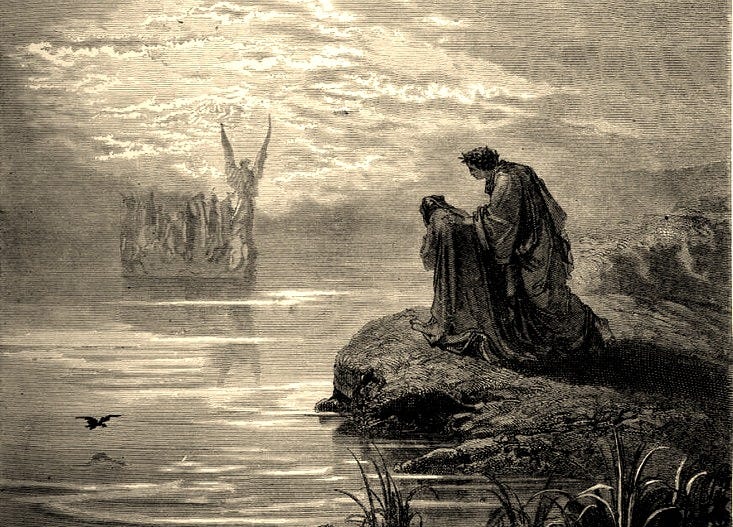
Dante had just crawled out of the butt crack of Hell with his guide Virgil, and they are now on the shores of Mount Purgatory. To say they are weary and exhausted is an understatement. Dante looks and smells like he had been swimming in a sewer. And Cato, the guardian of Purgatory, tells Virgil to clean Dante up and get the smell of hell off of him. Shaken and tear-stained they go to the water. And then they see it. A ship guided by a magnificent angel carrying human souls, all singing Psalm 113. The souls arrive at the shore and fall over themselves in joy to touch the ground.
It’s here that I think the most tender thing happens. One of those souls runs toward Dante and takes him in his arms with love so warm that it moves Dante to do the same. But alas, Dante cannot return the embrace because his hand keeps going through the shade’s back. Dante blushes in embarrassment, and the shade steps back with a smile. Then Dante realizes it’s Casella, his dearest friend. Casella speaks first and says, “As in my mortal body, I loved you then, so now I love you, free!” What an absolutely beautiful thing, to love someone free. Unencumbered by shame, trauma, or fear. To love someone free, I think, means to love someone in accordance with their being, in harmony with their existence. Never devouring, but always delighting.
In their mortal lives, Dante and Casella’s love for each other bloomed in the harmony they created. Dante would write love poetry, and his friend Casella (a gifted vocalist) would turn Dante’s poems into songs. So here on the shores of Purgatory, with the soot of hell still staining Dante’s clothes, he asks his dear friend to sing him a love song. Adding, “if you still remember those songs of love that used to still the yearnings of my heart.” Casella lovingly obliges and sings one of Dante’s love poems. Dante tells us, “I can still hear the sweetness of his sound,...and I stood listening so contentedly/it seemed our minds were touched by nothing else.”
This scene drips deeply into my soul. It finds a piece of me that is rarely seen and recognized. Like when someone reads the poetry of your heart that you’ve not been able to voice. It feels like a relief, an opening of the cage. It starts as a whisper, but the words grow into a shout, “that’s it! That’s what it says! That’s it!” And then hope, small but stubborn nonetheless, soars just above the darkness of our thoughts and with a bright talon, stirs the stagnant pool of despair just enough for us to realize we can love again, and it can be life-giving.
At its core this scene is an incredible example of how to move forward after escaping the hell you’ve been through. Life doesn’t come first, love does. Two friends come together in love, both giving of themselves through their gifts of song and poetry, and participate in the making of harmony itself.1 And the blemishes and stains of death recede and life returns when love is rightly shared.
Dante still had to climb Mount Purgatory, and you and I still have to tend to the work before us. But unlike hell, there is hope here. There is love here. There is harmony to create and life to be lived. And weak as we are, we have a gentle and caring guide. And when you are ready to stand up, do so knowing that the strength will come back to you with every step you take.
Esolen in his introduction to Purgatory writes on this on p. xxvii. See also Canto 2, Purgatory for a complete depiction of this scene.
Thanks, a good reflection, I expect I'll come back to it a few times.
Quasi-related: for several years, I've taken Dante's Purgatory as my travel read anytime I fly. Like it's a book for ascending. The lines about shaking off Hell for fresh winds escape me now, but it's something I circle back to.
Sort of a parallel to your thoughts here, Chase, was hearing my audiobook for the first time, and how the narrator so brilliantly captured the words through dramatic performance. It felt like a Dante/Casella moment.
Literature has a tendency to meet us where we are. Good thoughts, here.